Admiral v00047: Low-Level Watchdogs, Offline Telemetry Buffers, and Power Metrics
Introducing physical hardware watchdog petting, offline AirDetect buffering, integrated battery metrics, and emergency provisioning recovery.

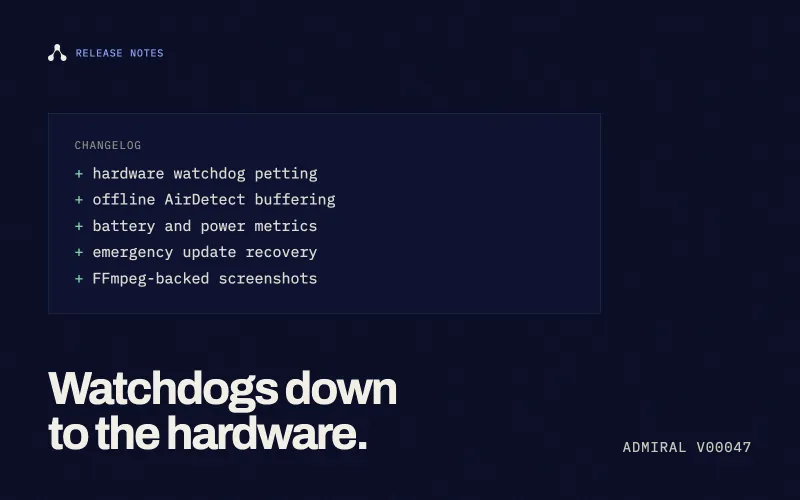
Admiral v00047 focuses on hard hardware-level survivability, deep offline tolerance for remote spatial sensors, and enhanced power profiling for mobile edge nodes.
Here is a breakdown of what has landed.
1. Physical Hardware Watchdogs & Boot Safety
When edge nodes sit in remote or physically inaccessible locations, operating system deadlocks must be recovered by the silicon itself. We have introduced deep, low-level safety loops:
- Hardware Watchdog Petting: The host supervisor now natively pets
/dev/watchdog. If the core agent runtime deadlocks or fails to cycle, the physical hardware will hard-reboot the machine. - Aggressive Boot Guard Timers: We have tightened connectivity check windows to get devices back online faster. On a fresh first-time boot, the system now reboots after 1 hour of no connectivity (down from 6 hours). For running nodes, the automated non-communication reboot threshold has been pulled in from 7 days to 3 days.
- Emergency Update Recovery: Introduced an out-of-band rescue and emergency update flow inside the Provisioning API to recover partially bricked or un-paired units.
- Persistent Filesystem Recovery: Resolved an onboarding issue by attempting to repair and resume the existing local filesystem on a reboot, rather than wiping and writing a fresh layout.
2. AirDetect Offline Buffering & BLE Refinements
Our spatial analytics engine can now survive long-term WAN dropouts without losing critical footprint data:
- Metrics Caching & Buffering: AirDetect telemetry metrics are now cached and buffered locally during offline periods, flushing smoothly once WAN paths recover.
- Decoupled BLE Provisioning: Reworked our Bluetooth provisioning flows to run reliably even if the primary AirDetect analytics engine is disabled.
- BLE Spec Fixes: Handled structural edge cases inside the local BLE spec parser to prevent malformed advertising frames from interrupting pairing loops.
3. Hardened Networking & Control Plane Optimization
We continue to reduce management-overhead noise on expensive satellite and cellular uplinks:
- No More Latency Monitor Overhead: Removed the dedicated latency monitoring service. Ping and link quality diagnostics are now multiplexed into existing, low-overhead streams.
- Targeted SD-WAN Handshakes: The SD-WAN path-selection logic now attempts to ping our core API server first, verifying access to our most critical control interface before routing ambient traffic.
- Traffic Grace Periods: Added startup grace periods and increased sender timeouts across metrics and log pipelines to prevent boot-up cascades from polluting control sockets.
- State Preservation: Integrated a dedicated network connection store to prevent interface transitions from dropping active connection maps.
4. Workload Isolation, Screens, & Power Profiles
- Low-Power Battery Metrics: The system now automatically detects hardware battery interfaces, exposing charge states, voltage, and drain telemetry profiles in native system metrics.
- FFmpeg-Backed Screenshots: Screen visual diagnostics now utilize FFmpeg captures, adding support for RK3326-based displays.
- Workload Startup Fixes:
- Workloads now start correctly on hosts lacking AppArmor.
- Errors are no longer swallowed during initial workload execution.
- Workload target configurations are only applied when a functional difference or update is detected.
- Fixed image pulling failures on offline boots.
5. TUI Adjustments
- Compact Layouts: Added a smaller, high-density Terminal User Interface (TUI) layout suited for small-screen visual terminals.
- Battery Support: Real-time physical battery levels are now rendered directly on the local terminal status head.
Admiral Engineering
Release notes
Release notes are written by the engineers who shipped the change, and reviewed by the platform team before publishing.