Deploy in a day
Live in days, not months
Flash a device, it enrols itself, and your workload is running. No custom OS builds, no update system to write, no site visit to set up.
AdmiralOS · Fleet platform for robots and edge AI
Turn one Dockerfile into a signed, immutable OS for every robot and edge AI device you ship. Deploy in a day, update without bricking, and fix the fleet without a site visit.
01 / 10 · Autonomous robotics
Humanoid robot
Ships for
 What is Admiral
Admiral bundles an immutable Linux OS, the fleet console, safe over-the-air updates and the security layer into one product. Your team ships the robot. Admiral keeps every one of them running.
Admiral
Deploy in a day
Flash a device, it enrols itself, and your workload is running. No custom OS builds, no update system to write, no site visit to set up.
Scale from 10 to 10,000
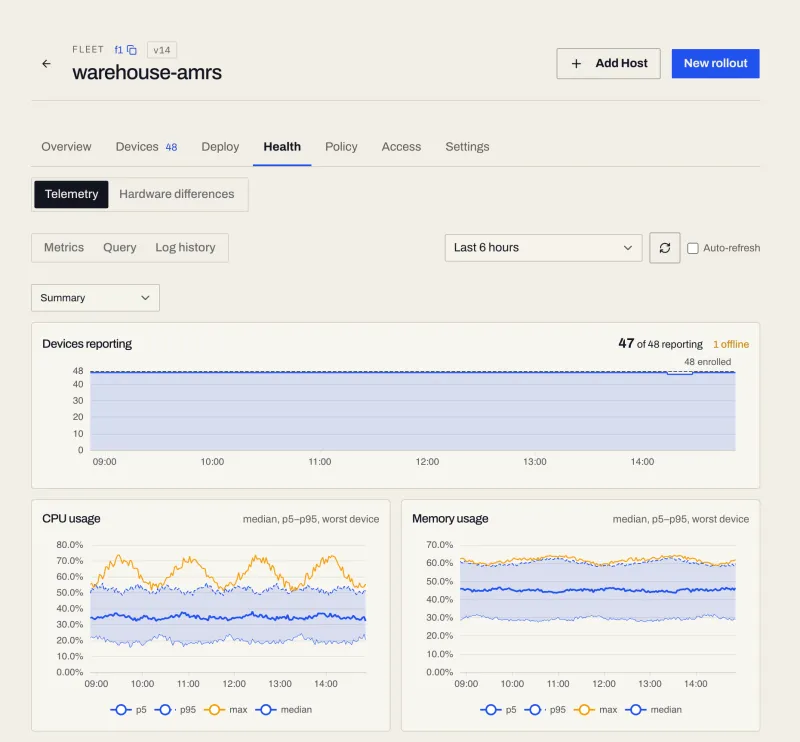
Health, logs and outbound-only remote access for every device. Most faults are caught and rolled back before anyone in the field notices.
Secure for life
Signed images, hardware identity and security patches for the life of the device come built in. Your engineers ship robot features, not infrastructure.
The console
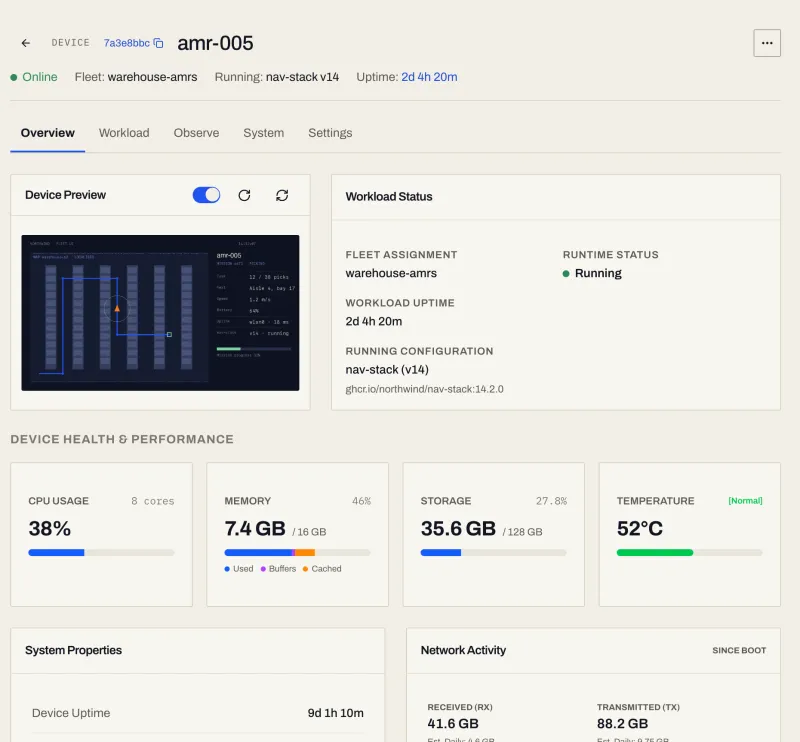
One console for every device you ship: what is running, what changed, and what each machine is doing right now. No SSH sessions, no spreadsheets.
How it works
Your Dockerfile compiles into an immutable, signed OS image for your exact hardware: x86, ARM or RISC-V.
Devices set themselves up on first boot, with no one on site. Each gets its own hardware identity.
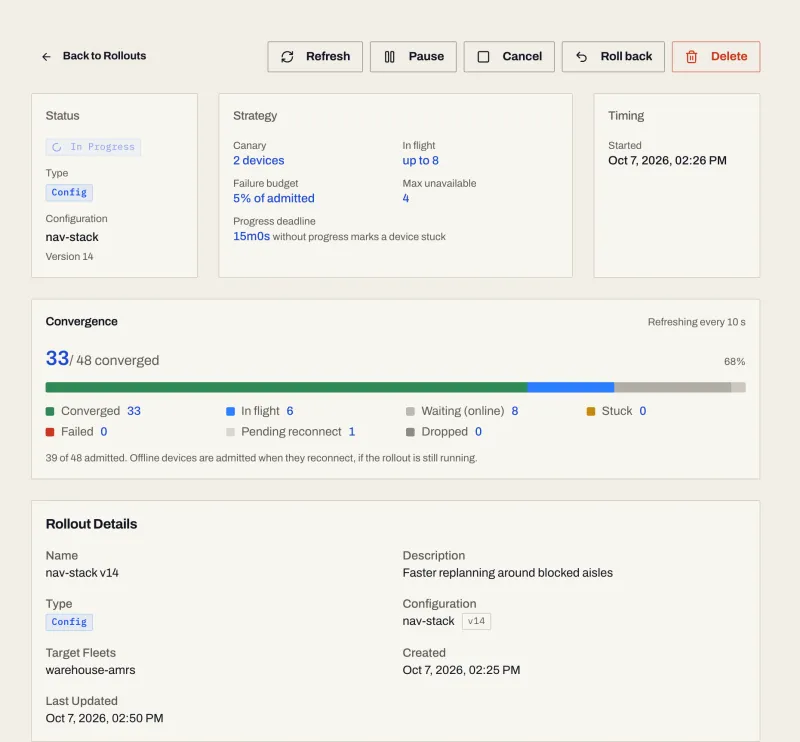
Staged rollouts install to a spare partition. The health check passes, or the device rolls itself back.
Live health monitoring, outbound-only remote access, and security patches for life, even offline.
Dockerfile
FROM ubuntu:26.04
RUN  apt-get install -y \
     ros-jazzy-base perception-stack
COPY config/ /etc/admiral/
CMD  ["/opt/perception/run"]
admrl rollout status robotics‑autonomy ‑‑watch
14:22:05 amr-prod-aus-0187 pulling_image
14:22:09 amr-prod-aus-0187 pulling_image -> starting
14:22:12 amr-prod-aus-0187 starting -> converged
14:22:12 counts converged 1/412, admitted 1, in flight 0, failed 0
14:22:41 counts converged 412/412, admitted 412, in flight 0, failed 0
Immutable Linux · No inbound ports · Offline‑first · Post-quantum crypto

 The platform
Before the cloud, every software company racked its own servers. Today every robotics company builds its own update system, device agent and remote access. Admiral is that layer, done once and done properly.
The whole rootfs ships as a layered OCI image. Every device runs the exact same build, so nothing drifts in the field.
Canary a release to a few robots, expand automatically when they stay healthy, roll back on its own when they do not.
Metrics, logs and on-demand screenshots from every device, streamed to one console without opening an inbound port.
GPUs, cameras, CAN buses and serial devices pass straight through to your workload. NVIDIA CUDA support is rolling out now.
Stays online over weak 4G and roaming Wi-Fi, keeps working offline, and catches up when the link comes back.
Signed images, per-device hardware identity, outbound-only connections and hybrid post-quantum TLS. Patches for the life of the device.
Where it runs
In the field
Customer story · Robot for Hire
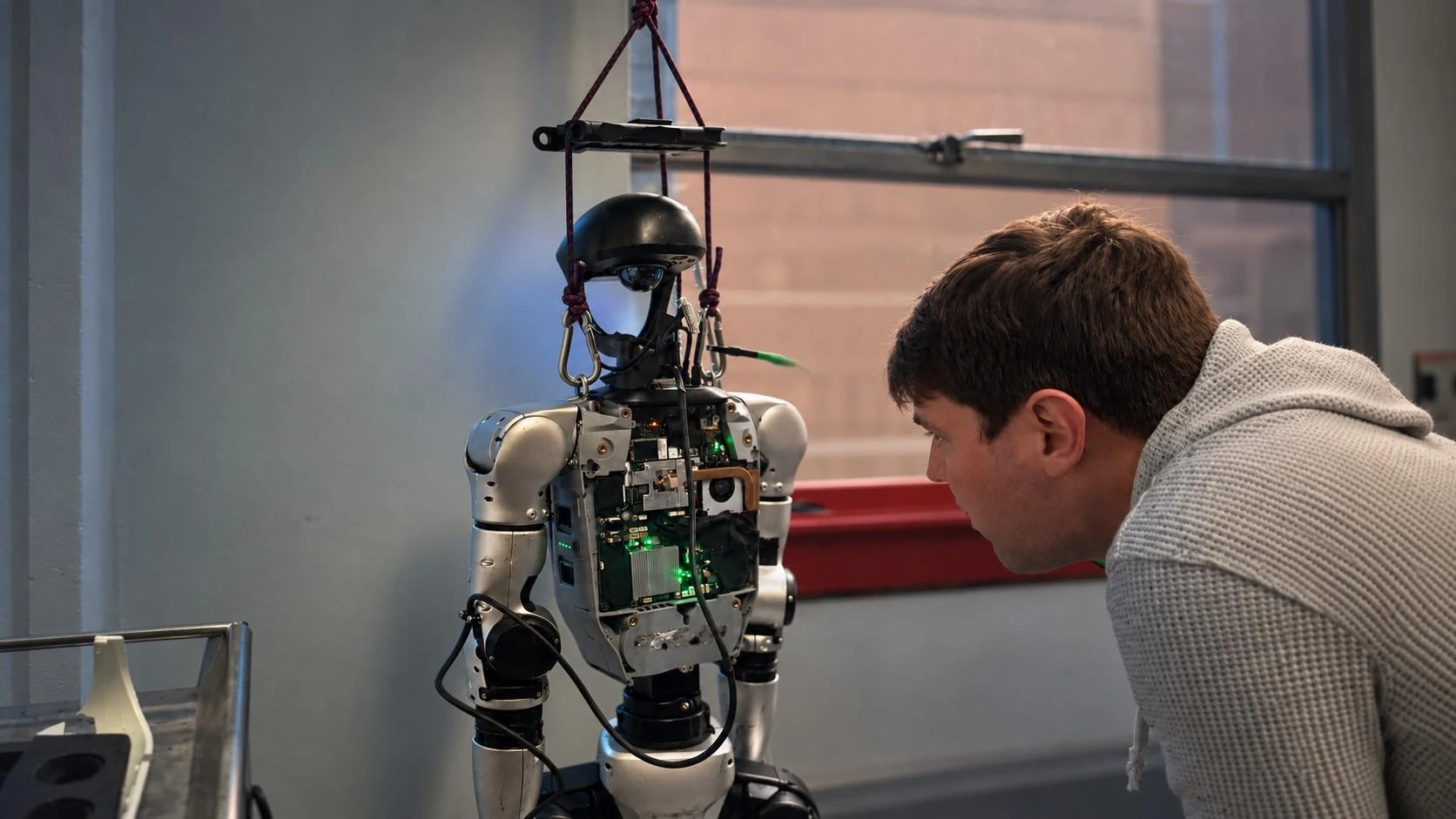
Robot for Hire migrated Rocco, their humanoid, to AdmiralOS and demonstrated it live at an AWS event the following day. No platform team and no re-flashing on site.
“It worked flawlessly.”
Product demo
Four minutes, end to end
Fleet build, signed rollout and rollback, end to end.
Compare
Moving from a homegrown stack, Balena or Mender? Keep your Dockerfile and registry; our engineers get your first devices across in days. How the move works
Scroll to compare
| Capability | Build in-house | Balena | Mender | JFrog Connect | Admiral |
|---|---|---|---|---|---|
| Platform approach | Custom stack | balenaOS + cloud | OTA + device tools | Agent + JFrog platform | OS + fleet platform |
| Primary focus | Your product | Containerised edge apps | Embedded OTA | IoT / edge DevOps | Physical AI fleets |
| Disconnected deployment | You build it | Offline reflash workflow | Enterprise / offline updates | Self-hosted option | Offline-first operation |
| Security approach | You maintain it | OS security + patching | Signed updates; enterprise RBAC | JFrog security integration | Signed OS + access controls |
| Getting started | Build and integrate | Flash OS + deploy containers | Integrate client + update image | Install agent + connect platform | Build, enrol, deploy |
From public product documentation, October 2026. Features vary by plan and hardware.
Enterprise
The controls procurement asks about are already in the product.
Volume pricing, a named technical account manager, on-call escalation and custom SLAs for fleets past the free tier. Security questionnaires and DPA requests go to security@admrl.co.
From the blog
31 Aug 2026 · 4 min read
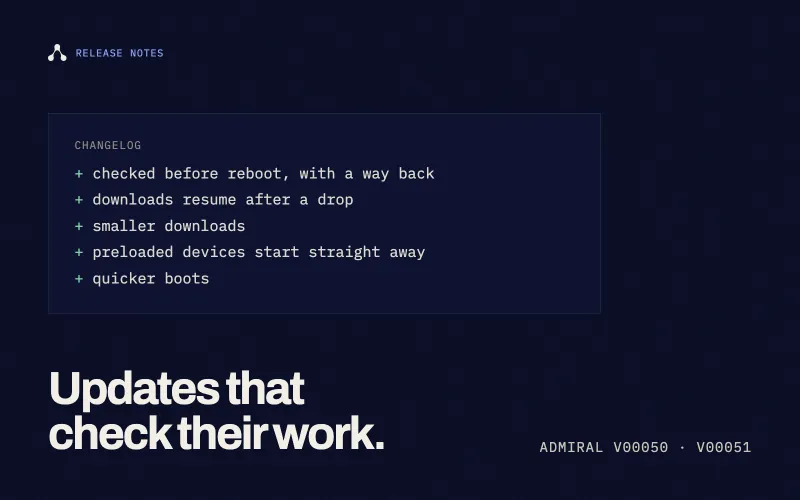
Updates that check their own work before a reboot, downloads that pick up where they left off, and devices that get to work faster on first boot.
Admiral Engineering
19 Aug 2026 · 3 min read
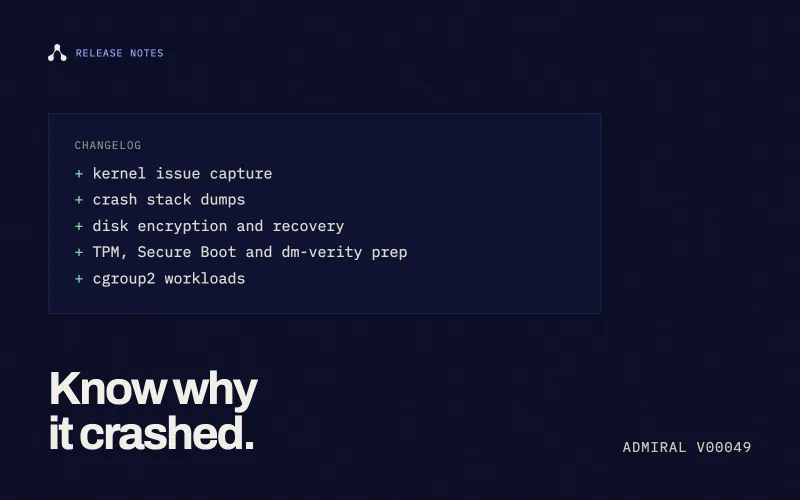
Introducing TPM/Secure Boot prep, dm-verity, automated crash recovery, cgroup2 workload management, and massive image pull refactors.
Admiral Engineering
15 Jul 2026 · 2 min read
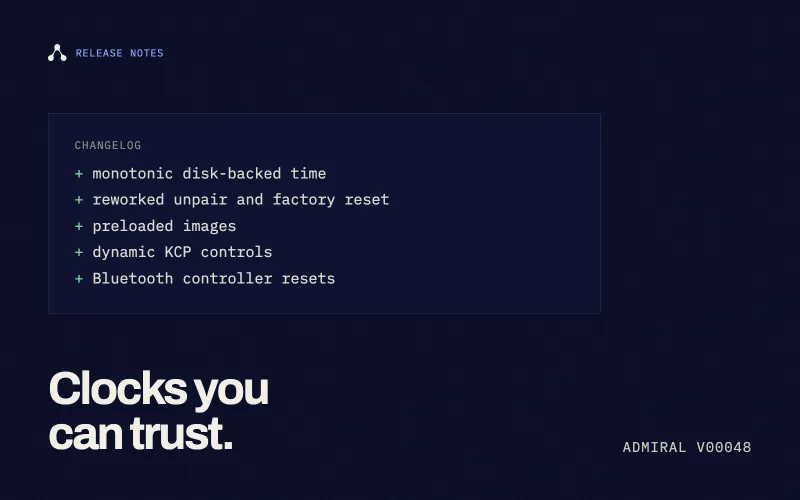
Introducing monotonic disk-backed time logging, factory reset reworks, Shipwright image preloading, and dynamic KCP controls.
Admiral Engineering