Admiral v00049: Crash Diagnostics, Disk Encryption, and Cgroup2 Workloads
Introducing TPM/Secure Boot prep, dm-verity, automated crash recovery, cgroup2 workload management, and massive image pull refactors.

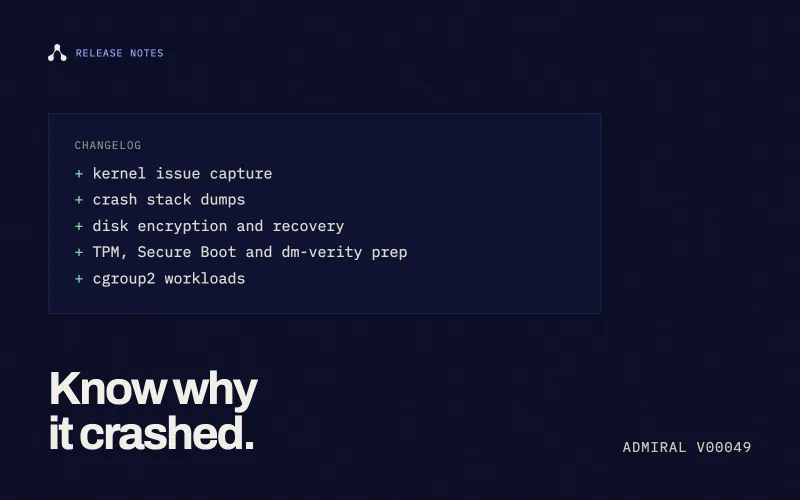
Admiral v00049 is a massive under-the-hood release focused on hardware-level security, deep crash diagnostics, and modernizing our workload isolation and image pull infrastructure.
Here is a breakdown of what has landed.
1. Deep Crash Diagnostics & System Recovery
When deploying to remote edge hardware, a silent kernel panic or a stuck process can mean a costly field visit. v00049 introduces aggressive new monitoring and logging to capture and recover from catastrophic states:
- Kernel Issue Capture: The host agent now actively captures and responds to a wider array of kernel issues, including Oops, soft lockups, hard lockups, panics, bad page states, and KASAN reports.
- Stuck Process Detection: Added an activity monitor to detect stuck processes, ensuring the supervisor can take action if the main runtime deadlocks.
- Crash Stack Dumps: The system will now dump its stack every ~5 minutes for debugging purposes.
- Historical Log Ingestion: On startup, Admiral now ingests the last block of the previous log, ensuring that crashes causing process exits or sudden reboots are properly recorded.
- Watchdog Retry Logic: Fixed hardware watchdog enablement to retry for up to 30 seconds, accommodating watchdogs that live in kernel modules that haven’t been loaded yet.
- Clock Reboot Fix: Fixed a weird issue where a stuck hardware clock could cause the system to reboot unexpectedly.
2. Security, Encryption & Hardware Metrics
We are laying the groundwork for enterprise-grade physical security and disk encryption across the fleet:
- Disk Encryption & Recovery: Implemented full disk encryption with remote recovery key support.
- TPM & Secure Boot: Initial implementations for TPM and Secure Boot are landing (full rollout coming soon).
- Image & Module Signing: Implemented dm-verity on images, kernel signing, module signing, and AppArmor enforcement. (Contact sales for details on enabling hardened modes).
- Hardware Metrics: Added disk SMART metrics, eMMC metrics, and NVME metrics to system telemetry (requires system >1.0.6).
- Expanded Hardware Detection: Added LPDDR4X detection and active reporting of OS versions and secure boot states.
3. Networking & Mesh Resiliency
We’ve overhauled our HTTP networking and Admiral Mesh cooldowns for maximum stability over degraded links:
- Unified Netclient Refactor: The Admiral netclient has been completely refactored into a drop-in replacement for all HTTP calls, bringing automatic retries, chunking, and QoS on the Linux link with backpressure monitoring. This now includes layer downloads.
- Mesh Cooldowns & Rebuilds: Refactored KCP cooldowns on the Admiral Mesh. Fixed a state where if the mesh client died, it would never rebuild, and fixed an integer overflow in the failure count logic.
- Link State Accuracy: Fixed an issue where pongs could arrive late and mark a dead link as active. Topology rotations are now allowed where no endpoints can be contacted but the link is up.
- State Preservation: Last contact times are now written to volatile memory to preserve state across service restarts.
- IPv6 Flap Fix: Fixed a bug where IPv6 rotations (which happen up to 30s) kept aggressively pushing specifications.
4. Storage, Image Management & Workloads
Workload isolation and image pulling have been massively streamlined and hardened:
- Image Pull & Heal Refactor: Refactored image pulling and caching. The system now automatically retries pulling layers with chunk resumption, and will automatically heal images if corruption is detected.
- Simplified Image Unpacking: Greatly simplified the image unpack process, and switched to using
qgroupson images to get filesystem size instead of walking the tree. - Cgroup2 Migration: Workloads have been moved to
cgroup2mounts instead ofcgroup. The supervisor will now attempt to unwedge stuck cgroups automatically without collision, and clean up zombies where possible. - Memory & Trimming: Fixed a bug where shared memory wasn’t being counted, causing OOM on the host. Implemented periodic disk trimming to extend flash life.
- Workload Fixes: Fixed port mapping on workloads, fixed bugs starting workloads with non-interactive states, and added a Volumes API for frontend integrations. A diagnostics log is now written directly from the workload manager.
5. Provisioning & Platform Polish
- WiFi & WPA3: Refactored WiFi scanning and connections. Admiral now manages
wpa_supplicantdirectly, probing and supporting WPA3 networks. - Identity & Installer Refactor: Refactored identity management (including wiping, resetting, and isolation states), installer steps, and the update staging and flow.
- Disk Selection & eMMC Life: Implemented new disk selection methods to always mount the disk where Admiral runs from. Removed
discard=asyncto preserve eMMC life. - Reboot & Offline Timings: Refactored rebooting behavior (requires system >1.0.6) and tweaked offline timings - nodes will now automatically reboot after 1hr from boot with no connectivity.
- Dynamic Feature Detection: Added dynamic detection for BPF and AppArmor support.
Admiral Engineering
Release notes
Release notes are written by the engineers who shipped the change, and reviewed by the platform team before publishing.